
 Posted by
 What It Really Takes to Build a Temporary Outdoor Concert Stage
As another summer concert season begins to wind down, I’m reminded of a very different time in my life. These days, summer concerts might mean deciding which shows I want to attend, which artists I’d like to photograph, or whether I really want to spend an evening standing outside in the heat with a camera around my neck. But there was a time when summer concerts meant something entirely different.
We built them.
Before I eventually transitioned into the role of Entertainment Manager, I learned about concert production the old-fashioned way.
I got my ass kicked a few times.
When our traditional summer concert series began, there was no shortage of work to be done. My duties included rigging, stage construction, running cable and focusing PAR cans from inside the truss… Up in the air. There is a tremendous difference between standing in an audience and looking at a concert stage and being part of the team responsible for creating it. The audience sees the finished product. I learned what it took to get there. And believe me, there is a lot that happens before the first musician ever steps onto that stage. It all starts with a parking lot and a vision.
A Parking Lot and a Dream
Most people attending an outdoor concert probably don’t give much thought to what the space looked like a few days earlier. They arrive to find a stage. Lights. Speakers. Thousands of chairs. Food. Security. Perhaps a beer tent. And eventually, their favorite band. What they don’t see is the transformation that took place before they arrived. Creating a temporary outdoor concert venue is not simply a matter of pulling up with a trailer, unfolding a stage and plugging in a few speakers. A full-blown headlining concert involves thousands of individual details. Yes.
Thousands.
And nearly every one of those details has to be considered before construction even begins.
Before Anything Leaves the Warehouse
The production begins on paper. Measurements are taken and CAD drawings are created. Those drawings eventually become the roadmap for everything that follows. How large will the performance footprint be? How high will the stage sit above the ground? How many musicians will be performing? Do we have a stage plot? Where will each musician be positioned? How much space is required for backline? Where will guitar world be located? Monitor world? Lighting world? And what about Front of House? Every piece of the puzzle has to be accounted for. How many pieces of truss are required? What lengths? How many perimeter columns? How many lighting fixtures? What gel colors will be used? How many PAR cans are needed for each particular color? How many intelligent lighting fixtures are required? How many audio cabinets? How many subwoofers? How many monitor wedges? How much cable? How much power? Every answer affects another part of the production. The drawings aren’t simply showing you where everything goes. They help determine what needs to be brought to the site in the first place. Because discovering you’re missing something after arriving at the venue is not exactly the kind of surprise anyone wants. Every road case had to be prepared. Every piece of equipment had to be accounted for. Because before construction could begin…
Everything had to be ready to leave home.
Stage Left, Stage Right… and Don’t Get Confused
The location of the various production departments also has to be established. Monitor control is typically positioned stage left, while lighting world—where lighting equipment, dimmers and power distribution may be located—is often positioned stage right. Now, before anyone gets confused… When you’re standing on the stage looking out toward the audience, stage left is on your left and stage right is on your right. When you’re standing in the audience looking toward the stage, those same sides become house left and house right. Simple enough? Welcome to concert production.
But I digress.
Building the Skeleton
Once the planning has been completed, it’s time to start turning drawings into reality. Before a lighting fixture can be hung… Before a speaker can be flown… Before a musician can walk onto the stage… You need a structure capable of supporting everything. Perimeter columns and connecting trusses create the framework for the temporary structure. Depending upon the design, the framework may actually be erected before the stage platform itself is completed. Eventually, the structure supports a roof, lighting trusses, speaker hangs and other production equipment. And this is where something else enters the conversation.
Physics.
Suddenly, we’re not simply talking about making something look impressive. We’re dealing with weight. Load distribution. Gravity. Hang points have to be established for motor hoists. Trusses have weight. Lighting fixtures have weight. Speaker systems have weight. And everything that is going to be suspended above the stage has to be properly considered. Because eventually, people are going to be working—and performing—underneath it.
Safety Isn’t Optional
And speaking of weight… Those massive concrete blocks positioned around an outdoor stage aren’t there because someone thought they looked cool. Concrete ballast is strategically used to help stabilize temporary structures. The standing truss. The roof. The lighting grid. The speaker hangs. Everything creates forces that have to be considered. And then there’s something every outdoor production must respect.
Mother Nature.
Wind can change everything. Rain can create additional concerns. Lightning can stop a production completely. Safety isn’t something added after the stage has been built. It is part of the planning from the very beginning.
But Where’s the Stage?
Before we put anything on the stage… We have to build the stage. And that can become tricky when you’re working on a surface that was never designed to support a concert venue. Perhaps you’re in a parking lot. Maybe a baseball field. A fairground. Or another open space. Is the surface level? Does the ground slope? Does it run off in a particular direction? If the downstage lip needs to be five feet above the ground, how do you ensure that the stage itself remains level? Suddenly…
Platforms become your best friend.
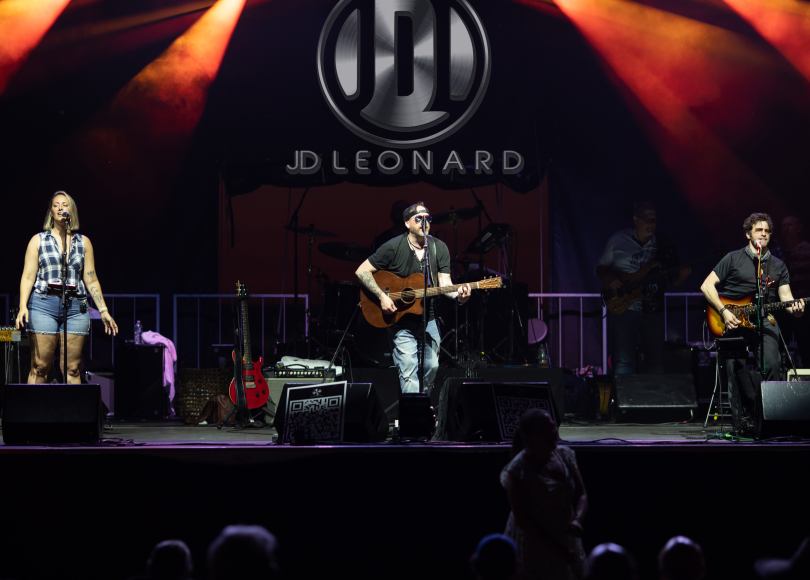
A temporary stage isn’t simply a collection of decks thrown together. Everything has to be properly positioned and leveled before the rest of the production can continue. Eventually, the performance deck begins to take shape. The roof is overhead. Monitor world has its location. Lighting world has its own area. And slowly… That ordinary parking lot begins looking like a concert venue.
Let There Be Light
A typical lighting plot may include three primary trusses: Downstage. Midstage. Upstage. Of course, more elaborate productions may incorporate additional positions, including downstage-mid and upstage-mid trusses. More trusses mean more fixture locations. More opportunities for depth. More movement. And more possibilities for the Lighting Designer. And don’t get me started on lighting columns! Many productions incorporate freestanding lighting columns positioned wherever the Lighting Designer wants them. Perhaps four columns are positioned behind the drum kit. Maybe a couple more are placed along the sides of the stage. Or perhaps they’re strategically positioned in exactly the right location for the Lighting Designer to blind the audience. We’ve all been there. Once the artist’s lighting plot has been provided—or the Tour Manager has signed off on the available house plot—the fixtures can finally be hung and focused. PAR cans may occupy the downstage, midstage and upstage trusses. More elaborate productions may include intelligent fixtures, including Robe units and other moving lights. Those fixtures don’t necessarily have to remain overhead, either. Intelligent lighting can be positioned directly on the stage floor, creating uplighting or completely different angles across the performers. And then comes fog or theatrical smoke. Suddenly, the beams themselves become visible. And now…
We’re starting to look like a concert.
Soft Goods Make Everything Look Better
Of course, not everything incorporated into a stage design is about structural support. Some of it simply looks cool. One of my favorite visual elements has always been the use of soft goods. Black curtains can provide a dark backdrop behind the stage, helping conceal infrastructure and creating a clean visual canvas. Then add white spandex. Stretch it into different geometric shapes. By itself, it might not look particularly impressive. Put it in front of black draping and place it in the hands of a talented Lighting Designer… And suddenly, the entire appearance of the stage changes. Color changes its personality. Lighting angles create depth and shadows. Intelligent fixtures create movement. Fog and smoke add another dimension. The same pieces of white spandex can look completely different from one song to the next.
That’s the beauty of a talented Lighting Designer.
Monitor World, Audio and Front of House
Once the stage plot has been finalized, monitor placement can be established. Where will the monitor wedges go? How many musicians need them? What additional equipment is required? Monitor world is responsible for what the performers hear on stage. But while the monitor engineer is concentrating on the band… Someone has to worry about what the audience hears.
Enter Front of House—FOH.
The FOH audio engineer mixes the sound for the audience. The lighting console may also be positioned at FOH, allowing the Lighting Designer to see the production from the audience’s perspective. Depending upon the size of the venue, FOH might be located 100 to 150 feet from downstage.
Think about that.
Everything happening on the stage needs to communicate with people sitting more than a hundred feet away. Which means…
Cables.
Lots and lots of cables.
Powering the Dream
For many temporary outdoor productions, a generator becomes the primary source of power. Sounds simple enough, right? Call the generator company. Turn it on. Plug everything in.
Not quite.
Lighting requires substantial power. Audio requires substantial power. Dimmers require power. Intelligent fixtures require power. Monitor world requires power. Lighting world requires power. FOH requires power.
And all of those power requirements have to be planned and properly distributed. Then there are the power amplifiers—or powered speaker systems—required to deliver concert-level sound. Subwoofers may be hidden underneath the stage behind the stage skirt. Speaker hangs require their own infrastructure and connections. And somewhere in the middle of all of this…
Someone has to run every cable.
Power. Audio. Control. Lighting. And FOH may be more than a hundred feet away. The audience will probably never see most of those cable runs. And honestly?
That’s exactly the point.
When the doors open, the technology should disappear. The experience should take over.
The Forgotten Army
Of course, Production wasn’t the only department involved. Far from it. The CAD drawings also had to consider seating layouts. Building Services was responsible for helping transform that empty space into an actual venue. How many chairs? Where were the aisles? Where were the seating sections? How much room was required? Where were the access points? The stage was only one part of the picture. Then there was Catering, Security, Facilities, Housekeeping, Guest services. And everyone else who played a role in creating an experience for the patrons.
A concert production is never the work of one person. The riggers can’t do it alone. Lighting can’t do it alone. Audio can’t do it alone. Stagehands can’t do it alone. Building Services can’t do it alone. Production Management can’t do it alone.
Everyone is part of the team.
Wait… Has Someone Called the Band Yet?
After the drawings… The road cases…The truss…The roof…The stage…The ballast…The power…The lighting…The audio…FOH…Monitor world…The cable runs…The seating…And everything else that went into building the venue…
Someone should probably call the band.
And yes…
We finally did.
The Final Checklist
Before the doors open, every department has its own questions. Have the speakers been tuned and EQ’d? Have the monitors been checked? Have the lighting fixtures been focused? Have the intelligent lights been properly addressed and assigned within the lighting control system? Are the dimmers receiving the required power? Is the audio system operational? Is the lighting system operational? Is everything communicating properly? Do we finally have the green light? Only after all of that preparation can the production truly be ready. And remember… For the audience, the concert may only last two hours. But for the people who built it? The day began a long time ago.
When the Concert Is Over…
Eventually, the final song is played. The encore ends. The audience heads toward the parking lot. For them… The concert is over. For us?
Not even close.
A show ending at 10:00 PM doesn’t mean everyone is heading home at 10:15. There were plenty of nights when the audience had long since gone home and we were still working. Sometimes until 2:00 in the morning. Sometimes 4:00. Everything now has to happen in reverse. The lighting fixtures come down. Audio is disconnected. Cables are pulled. Speaker systems are removed. Trusses are lowered. The roof comes down. The stage is dismantled. Road cases are opened. Equipment is packed.
And eventually, everything is loaded onto trucks.
Everything Has a Home
But here’s the important part. Everything that came out has to be accounted for. Every road case. Every section of truss. Every lighting fixture. Every PAR can. Every intelligent fixture. Every speaker cabinet. Every subwoofer. Every cable. Everything.
And when the equipment has been used… It has to be returned in the same condition it was in when it came out.
That’s organization.
A road case isn’t simply a box where you throw equipment at the end of the night. Everything has a home. And everything has to go back to that home. Because before we could finally go home and get some sleep…
Everything had to be put to bed first.
To me, concert production done right is the epitome of organization. The planning. The preparation. The communication. The safety. The teamwork. Every person has a responsibility. Every piece of equipment has a purpose. Every road case has a home. And when everyone does their job properly, thousands of people get to experience something they may remember for the rest of their lives.
From Asphalt… Back to Asphalt
Perhaps that’s what fascinated me most about temporary outdoor productions. It all started with a parking lot and a vision. For a few hours, that ordinary piece of asphalt became something entirely different. A concert venue. Thousands of people arrived. The lights came alive. The speakers shook the ground. The band performed. And for the audience, memories were created. Then the lights went out. The audience went home. And we began tearing it all down. Hours later, the trucks were loaded. The equipment was gone. The stage had disappeared. And eventually, we found ourselves standing in exactly the same place where it all began. An empty parking lot.
But those of us who helped build it knew what had been there. We remembered the planning. The sweat. The cable runs. The truss. The lighting. The sound. The teamwork. And perhaps most importantly…
What it took to make it happen.
Because when concert production is done right, the audience doesn’t see the work. They simply remember the show. And maybe…
That’s exactly how it should be.
 Long Island Sounds