 Posted by
 There are some concerts you attend.
There are others you experience.
Deep Purple at Northwell at Jones Beach Theater was very much the latter.
At 80 years old, vocalist Ian Gillan is no longer the singer who effortlessly unleashed those legendary high notes in “Highway Star,” “Lazy,” or “Space Truckin’.” Nor should anyone realistically expect him to be. Time has a way of reminding even the greatest performers that they are human.
But give Gillan credit: he tried.
And that effort was evident throughout the evening.
Deep Purple was scheduled to take the stage at 9:00 PM, but it wasn’t until approximately 9:30 that the house lights finally dropped. The reaction was immediate. The crowd rose from their seats as plumes of smoke from nearby joint smokers began drifting through the air.
For a moment, I was transported back to my earliest concert-going days—when smoking a joint at a concert was technically illegal and therefore something that had to be concealed, but was nevertheless very much accepted as part of the concert environment.
Then the lights came up.
And Deep Purple took us back several decades.
The current lineup is remarkable when you consider the collective experience on that stage. Gillan and bassist Roger Glover are both 80. Drummer Ian Paice is 78. Keyboardist Don Airey is 78. Guitarist Simon McBride, at 47, represents the relative youngster of the group.
And then there was the name that would eventually make this night unlike any other:
Ritchie Blackmore.
But that story deserves its own chapter.
For the first portion of the evening, this was about Deep Purple—and the band delivered.
Gillan: The Voice May Have Changed, But the Spirit Remains
Let’s address the obvious.
Ian Gillan’s voice has changed.
How could it not?
The man is 80 years old and has been singing some of the most demanding material in rock history for more than half a century. The sheer vocal power he once controlled simply isn’t there in the way it was during Deep Purple’s prime.
At times, particularly early in the performance, it almost appeared on the massive video screens as though Gillan was physically reaching for notes that his voice was no longer quite capable of delivering. It sounded as though his vocal chords hadn’t completely warmed up.
But there was something admirable about watching him try.
When the opening notes of “Highway Star” rang through Jones Beach, nobody was there expecting to hear the 1972 version of Ian Gillan. We were there to hear Ian Gillan in 2026.
And he gave us what he had.
That distinction matters.
Simon McBride: The Lost Art of the Guitar Solo
One of the evening’s great surprises came from Simon McBride.
It almost seems as though the traditional guitar solo has become a lost art.
Not here.
McBride reminded everyone exactly why the guitar solo became such an integral part of rock music in the first place.
His playing wasn’t simply filling space between vocal passages. He was making a statement.
His extended solo demonstrated an extraordinary level of technical ability, musicality and confidence, and for those of us who still appreciate the visceral thrill of a guitarist stepping forward and simply playing, it was one of the night’s highlights.
McBride may be the youngest member of the band, but there was nothing junior about his performance.
And Then There Was Don Airey…
WOW.
There really isn’t another word.
Taking on the keyboard position once occupied by the legendary Jon Lord is no small task. Lord’s Hammond B3 and Leslie combination became one of the defining sounds of Deep Purple, and Don Airey has more than earned the right to sit behind those keyboards.
His performance during “Lazy” was nothing short of extraordinary.
Airey’s extended keyboard feature became a musical journey all its own, beginning with Bach’s “Toccata and Fugue,” before weaving in recognizable passages from Ozzy Osbourne’s “Mr. Crowley,” “Ode to Joy,” “Weiss Heim,” and “Solfegietto,” ultimately segueing beautifully into “Perfect Strangers.”
It was the kind of keyboard showcase that makes you stop watching the screens and simply stare at the stage.
This wasn’t background accompaniment.
This was musicianship.
Ian Paice: No Solo Required
The only thing arguably missing from the evening was an actual drum solo.
But I’m not sure anyone was complaining.
At 78, Ian Paice hammered away at his kit all night as though it were Christmas morning and somebody had just handed him the greatest present imaginable.
Paice is the sole remaining member of Deep Purple’s classic lineup to have played on every studio album the band has released since its formation, and watching him behind that kit was another reminder that age does not necessarily diminish a musician’s ability to command a stage.
Sometimes you don’t need a solo.
Sometimes you just need to keep playing.
The Setlist
The evening moved through an impressive collection of Deep Purple material:
“Highway Star”
“A Bit on the Side”
“Into the Fire”
Simon McBride Guitar Solo
“Arrogant Boy”
“Lazy Sod”
“Lazy”
“When a Blind Man Cries”
“Diablo”
Don Airey Keyboard Solo
“Perfect Strangers”
“Space Truckin’”
“Smoke on the Water”
“Guinnesis”
“Hush”
And then came the moment nobody in that audience would forget.
But before getting there, there is one other part of the experience worth mentioning.
The Concert Experience Isn’t Always About What’s Happening on Stage
As someone who considers himself an experiencer, rather than simply a reviewer, I believe the surroundings are part of the story too.
Unfortunately, not everyone around me seemed to have received the memo.
There was a woman seated nearby who seemed far more interested in carrying on conversations than listening to the band. As the evening progressed, several of her rather intoxicated male companions joined in, and their conversations became increasingly difficult to ignore, often competing with the music itself.
It’s a shame, because at the prices concertgoers are paying today, the expectation should be pretty simple: you’re there to experience the performance.
Talk between songs, certainly. Sing along, absolutely. But carrying on a conversation throughout the music doesn’t just diminish your own experience—it diminishes the experience of everyone within earshot.
The irony wasn’t lost on me.
I was there to experience Deep Purple.
And I wanted to hear every note.
Then Came “Smoke on the Water”
By the time Deep Purple reached “Space Truckin’,” the evening had already delivered everything anyone could reasonably expect from a legendary band that has been performing for more than five decades.
But there was no traditional walk-off.
No leaving the stage.
No waiting for the house lights to come up.
Instead, Ian Gillan remained onstage.
And then he introduced a name that hadn’t stood alongside these particular bandmates on a Deep Purple stage in more than three decades.
Ritchie Blackmore.
The response from Jones Beach was immediate.
This wasn’t simply another guest appearance.
Standing on that stage were four members of the legendary Deep Purple Mark II lineup: Ian Gillan, Roger Glover, Ian Paice—and now Ritchie Blackmore.
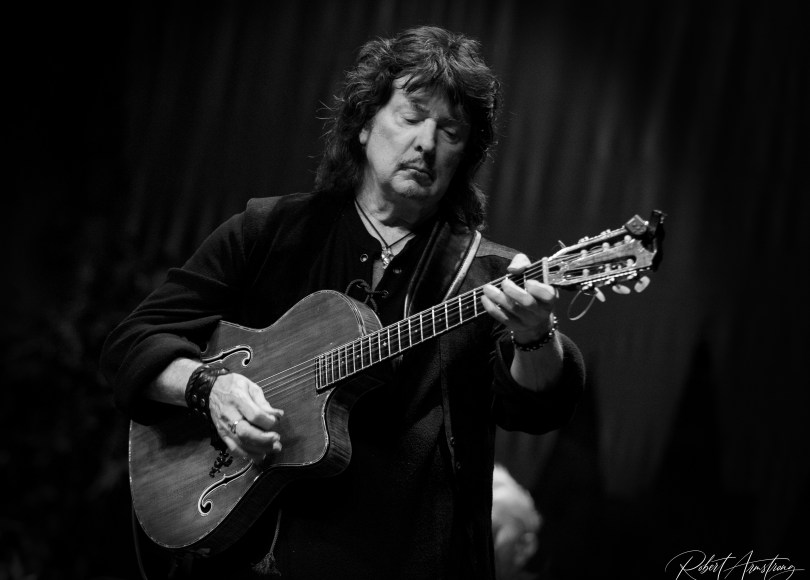
Blackmore, 81, stepped onto the stage carrying the history of Deep Purple with him.
He had reportedly contacted Gillan only days earlier about joining the band for a song, and after Gillan enthusiastically agreed, Blackmore announced his impending appearance himself.
Nobody quite knew what to expect.
Blackmore himself had acknowledged that he hadn’t played electric rock music in approximately 25 years, having devoted himself primarily to acoustic Renaissance music.
Then he plugged in.
And Jones Beach waited for the opening notes of perhaps the most recognizable guitar riff in rock history.
“Smoke on the Water.”
What happened next deserves more than a paragraph buried inside a concert review.
It deserves its own story.
Because for one extraordinary moment at Jones Beach, history wasn’t being remembered.
History was standing onstage.
And once Blackmore left, Deep Purple wasn’t finished.
The band remained onstage, continuing with “Guinnesis” before bringing the evening to its final conclusion with “Hush.”
No traditional encore.
No curtain call.
Just Deep Purple continuing to play.
And perhaps that was the most fitting way to end the night.
Because after everything we had witnessed, the message seemed remarkably simple:
They’re still here.
They’re still playing.
And after more than half a century, Deep Purple still has something to say.
Ritchie Blackmore Returns: A Moment of Rock & Roll History at Jones Beach
There are moments in music that you can anticipate.
There are moments you can hope for.
And then there are moments you know are coming—and somehow still manage to leave you speechless when they actually happen.
For me, this was one of those moments.
By the time Deep Purple reached the latter portion of its set at Northwell at Jones Beach Theater, the atmosphere had changed. There was an unmistakable sense of anticipation hanging over the audience. While not everyone may have known exactly what was about to happen, it certainly seemed that most people had figured it out.
I knew.
I had known firsthand that Ritchie Blackmore was going to appear.
And yet, when he actually walked onto that stage, I felt the same elation as everyone around me.
If there were still people sitting, they didn’t remain seated for long. The audience rose with an enthusiasm that, quite honestly, seemed greater than the raising of the flag.
This was Ritchie Blackmore.
On a Deep Purple stage.
In 1993, Blackmore’s final departure from Deep Purple brought an end to one of rock’s most celebrated and complicated musical partnerships. His relationship with vocalist Ian Gillan had become increasingly strained, creative differences had taken their toll, and Blackmore eventually moved in another musical direction, devoting much of his attention to the Renaissance-inspired music of Blackmore’s Night.
Decades passed.
Deep Purple continued.
Blackmore continued.
And while the possibility of these musicians sharing a stage again seemed increasingly remote, rock music has a funny way of occasionally giving us the impossible.
“He’s Here.”
The circumstances surrounding the reunion were almost as remarkable as the reunion itself.
According to reports, Blackmore contacted Ian Gillan only days before the Jones Beach performance and asked about joining the band onstage for a song. Gillan enthusiastically agreed. Blackmore subsequently announced the appearance himself.
And then, suddenly, it was no longer a rumor.
It was happening.
Ian Gillan introduced him.
Ritchie Blackmore walked onto the stage.
At 81 years old, Blackmore was returning to the electric rock stage after approximately 25 years focused primarily on acoustic Renaissance music. By his own admission, he was nervous about the prospect.
And who could blame him?
There was an enormous amount of history standing behind that single guitar.
What struck me almost immediately was the reaction of the musicians themselves.
There was an obvious nervous enthusiasm among the band. Yet there were smiles. There were warm greetings. There were light embraces.
Ian Gillan.
Roger Glover.
Ian Paice.
Don Airey.
Simon McBride.
Even McBride, the guitarist who had spent the evening carrying the guitar duties with remarkable skill, greeted Blackmore warmly.
For a brief moment, the past and present of Deep Purple seemed to occupy the same stage.
And then Blackmore strapped on the guitar.
The First Notes
There are guitar tones.
And then there are signatures.
The opening notes were unmistakable.
The tone was as rich as Richie himself.
There was no mistaking who was standing in front of us.
It was Ritchie Blackmore.
And then came the riff.
“Smoke on the Water.”
The audience erupted.
Almost instantly, phones appeared throughout the crowd as people pressed record, desperately trying to capture something they knew they might never see again.
For the thousands of people standing in front of that stage, this wasn’t simply another performance of one of rock’s most recognizable songs.
It was history happening in real time.
Nobody needed to be told to stand.
Nobody needed encouragement.
The audience was already on its feet.
Not 1972. Not 1984. Not 1993.
There is inevitably going to be discussion about Blackmore’s playing.
He is 81.
He hadn’t performed electric rock music regularly in approximately 25 years.
The fiery, aggressive attack that defined his playing during Deep Purple’s classic years has naturally evolved. What came from his amplifier that night wasn’t an attempt to recreate the Ritchie Blackmore of 1970 or 1972.
It was something else.
It was Ritchie Blackmore in 2026.
And that’s an important distinction.
Could he have played the riff with the same explosive aggression he possessed in his prime?
Of course not.
But that wasn’t really the point.
The point was that the man who created that sound was standing onstage with the musicians who helped create the music that changed rock forever.
And when those familiar notes rang across Jones Beach, nobody seemed particularly interested in judging whether they were played with the speed or ferocity of decades past.
They were simply listening.
Watching.
Remembering.
And recording.
Four-Fifths of Mark II
For those who may not fully understand the significance, standing on that stage were four members of Deep Purple’s legendary Mark II lineup:
Ritchie Blackmore.
Ian Gillan.
Roger Glover.
Ian Paice.
Four musicians whose work together helped establish the blueprint for hard rock and heavy metal.
Their history is complicated.
Their relationships have been complicated.
Their careers have taken very different paths.
But for those few minutes at Jones Beach, none of that mattered.
They were together.
Again.
And there was something profoundly moving about seeing Gillan, Glover and Paice welcome Blackmore back onto the stage.
There were no grand speeches necessary.
No elaborate production.
Just musicians who had shared one of the most important chapters in rock history standing together once again.
And Then It Was Over
Blackmore’s appearance was deliberately brief.
He had come to play one song.
He played it.
And then he left the stage.
There was an enormous standing ovation, although calling it a “standing ovation” almost feels inadequate because virtually nobody had remained seated throughout the performance.
And then something else happened that made the evening even more unusual.
Deep Purple didn’t leave.
There was no traditional encore.
After Blackmore’s departure, the band continued with “Guinnesis” and eventually brought the night to its conclusion with “Hush.”
In other words, the historic reunion wasn’t presented as some elaborate finale designed to overshadow the band.
It was simply a moment within the Deep Purple performance.
A remarkable moment.
An almost impossible moment.
And then Deep Purple carried on.
I Knew I Was Watching History
As I stood there watching Ritchie Blackmore perform “Smoke on the Water” with Ian Gillan, Roger Glover and Ian Paice, I knew I was witnessing something extraordinary.
What I didn’t know was just how extraordinary the reaction would become.
I knew it would make news.
I knew fans would talk about it.
I knew every phone recording made from the audience would begin appearing online almost immediately.
What I didn’t anticipate was the sheer magnitude of the reaction that would follow nationally and throughout the music world.
Within hours, the Jones Beach appearance had transformed from an incredible concert moment into something much larger.
For those of us who were actually there, however, none of that mattered yet.
We weren’t thinking about headlines.
We weren’t thinking about social media.
We weren’t thinking about tomorrow’s articles.
We were simply standing at Jones Beach watching Ritchie Blackmore play “Smoke on the Water” with Deep Purple.
And for one brief, unforgettable moment, the years disappeared.
The music was familiar.
The faces were familiar.
The riff was unmistakable.
But the moment?
That was something none of us had experienced before.
And I have a feeling that, for everyone fortunate enough to have been there, it is something we’ll be talking about for the rest of our lives.
 Long Island Sounds
Thank you — great to have local coverage of this. People all around the world were amazed by this, it really seems to have been a special moment. After following these guys for over 50 years, I wish I was there, your account is the nearest I’ll get. I realize we all hate people talking and just filming shows, but at least the videos helped me see it.
LikeLike
I was so happy to be there and the news took the world by storm for sure!! I do have videos on my FB concert photography page at facebook.com/robarmstrongFBPix if in fact you didnt get the review from there. and by all means give my page a LIKE. Thanks!
LikeLike
Not a Facebook user (the company is toxic) but thanks anyway. Purple forever.
LikeLiked by 1 person
If FB wasnt my gateway to all the bands I shoot here on Long Island, I wouldnt use FB either! I totally get it!
LikeLike